
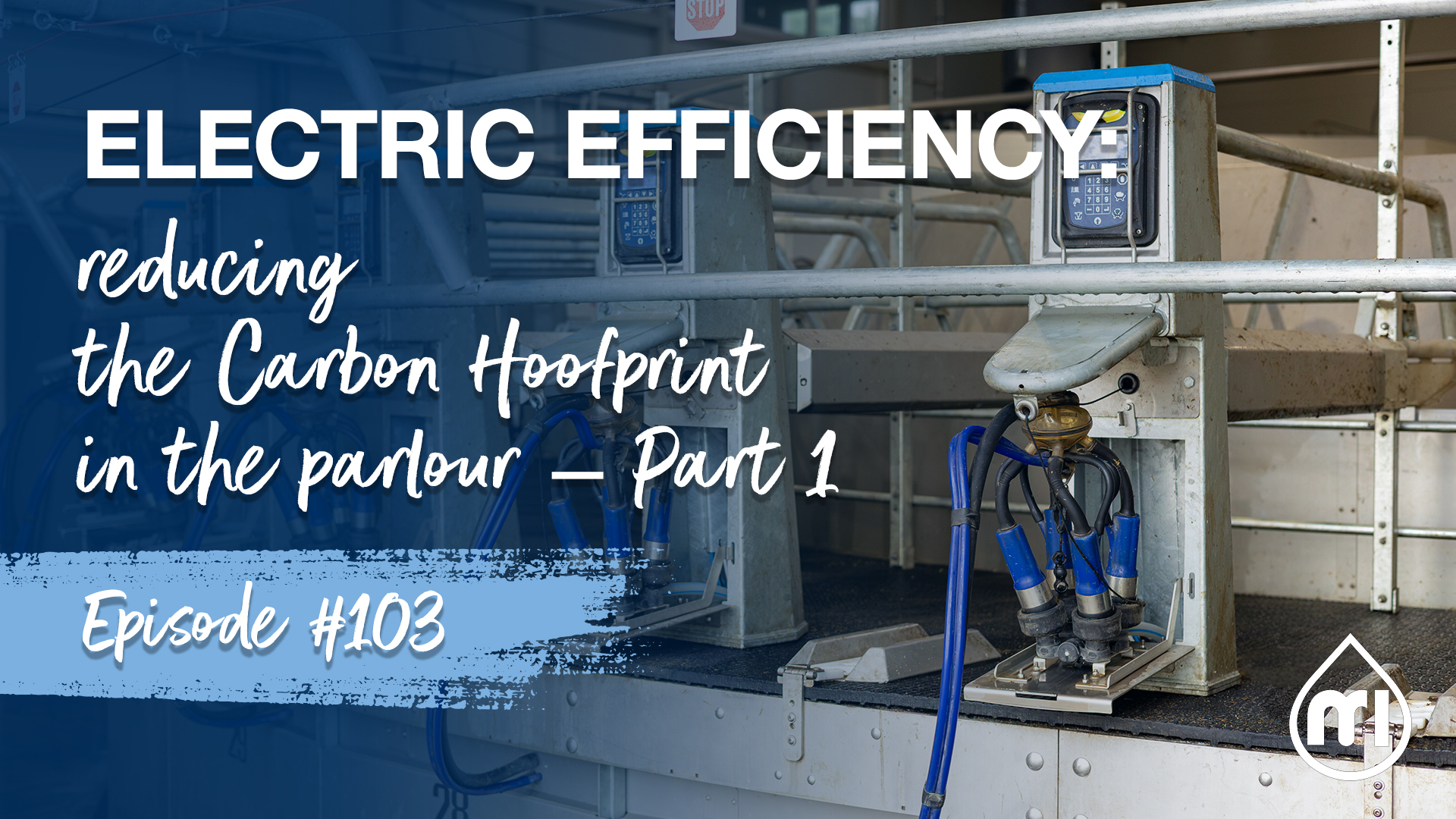
Electric efficiency: reducing the Carbon Hoofprint in the parlour – Part 1
Listen to this article!
Electric efficiency: reducing the Carbon Hoofprint in the parlour – Part 1
If you close your eyes in the milking parlour, you can hear the farm's greatest hits: the pulsator's metronome, the whoosh of milk, the clatter of metal, and the rhythmic shifting of the herd. It's a symphony of production. But beneath it all, there's that one demanding, aggressive bass note: the vacuum pump.
For decades, that noise has been the sound of your wallet weeping. It's an induction motor running like it just chugged five espresso shots: full speed, all the time, whether you're milking a single, lonely cow or a full hundred. It’s the sound of your electricity meter spinning faster than a DJ's turntable, relentlessly driving up your cost of production.
We talk about tangible costs like feed, diesel, labour, but electricity is the silent, invisible consumer. It's the ghost that eats your margins, only revealing itself when the monthly bill arrives, looking suspiciously large. We've talked about data and the liner's intimacy; now let's focus on the infrastructure that makes them go.
Welcome to 2026, where efficiency isn't just about litres per cow, but about kilowatts per litre. We worry a lot about the cow's personal carbon footprint (i.e., the methane). But let’s discuss the machine's contribution: the Carbon Hoofprint. How much energy does it really take to harvest that milk, and how do we get power consumption to finally leave production alone? Let's find out with Joao Pereira's support, MI VP Commercial EMEA-APAC & CX Expert.
The energy vampire
The vacuum pump is the heart of the milking system, a vital organ. Historically, it’s also been a notorious energy vampire. Traditional pumps are massively oversized for the "Armageddon scenario", that is, the washing cycle or the inevitable moment when a clumsy cow kicks a cluster off, causing a massive air leak.
Because it has to handle these air spikes, the pump runs at max RPM continuously. When the milking is smooth, it's making way more vacuum than needed. So, to protect the cows from being sucked into the next county, we vent all that excess power into the atmosphere using a regulator valve.
In strategic terms, this is like driving a high-performance sports car with the accelerator pinned to the floor and managing your speed by standing on the brake pedal. Sure, you're controlling the speed, but you’re wasting fuel, ruining your brakes, and generally being inefficient.
The solution is the Variable Speed Drive (VSD), the technological equivalent of putting a brain in the system. The VSD doesn't just "save power"; it's a listener. It uses a sensor to monitor the vacuum thousands of times a second.
Smart and steady: when demand is low (i.e., during calm milking), the VSD whispers to the motor: "Slow down, buddy." It supplies only the energy needed to hold the perfect setpoint (e.g., 42 kPa).
Ready to rumble: when a spike happens (e.g., washing starts or, gasp, the cluster comes off), it instantly screams: "Go, go, go!"
The result? Energy consumption often drops by 40% to 60%. But there is a hidden, priceless bonus: silence.
The physiology of silence: don't stress the cows
We seriously underestimate how much the constant, high-decibel drone of a full-speed vacuum pump stresses a dairy cow. Cows have great hearing, and that noise is like an obnoxious neighbour’s all-day garage band.
When a cow is in a loud parlour, her "fight or flight" response gets subtly triggered, releasing adrenaline and cortisol. In the parlour, adrenaline is the enemy of profit. It clamps down blood vessels and blocks the very receptors oxytocin needs to do its job.
Even a mild stress-hormone increase can lead to:
Late let-down: the machine runs longer, damaging the teat end and wasting time.
Incomplete milking: residual milk is left behind, which means less yield and a higher risk of mastitis.
Noise fights milk yield. A VSD-controlled pump runs at a polite shhh during milking. By upgrading, you're not just saving money; you're running a spa for cows. Lower noise equals faster, more complete milk let-down, less unit-on time, and a happier cow/operator team.
In conclusion, embracing the advancements of Variable Speed Drives in the milking parlour is not just a move towards efficiency; it's a commitment to the health of our cows and the sustainability of our operations. By addressing the relentless noise and the energy consumption of outdated systems, we can transform the milking experience for both the herd and the farmer.
As we step into a future where every kilowatt saved contributes to a reduced Carbon Hoofprint, it becomes increasingly clear that the path to progress is paved with innovation and care.
Don’t miss our next episode, where we will dive deeper into essential strategies and solutions that continue to reduce the Carbon Hoofprint in the milking parlour.
MI thanks Joao Pereira, VP Commercial EMEA / APAC & CX Expert.
References
Upton, J., et al. (2020). Energy consumption on dairy farms: A review of monitoring, data analysis, and efficiency metrics. Journal of Dairy Science.
FAO (2019). Climate change and the global dairy cattle sector: The role of the dairy sector in a low-carbon future. Rome.
Reinemann, D.J. (2018). Milking Machine Physics and Performance. University of Wisconsin-Madison.
International Dairy Federation (IDF). Guide to Energy Efficiency in the Dairy Chain.
Bruckmaier, R.M., & Blum, J.W. (1998). Oxytocin release and milk removal in ruminants. Journal of Dairy Science.